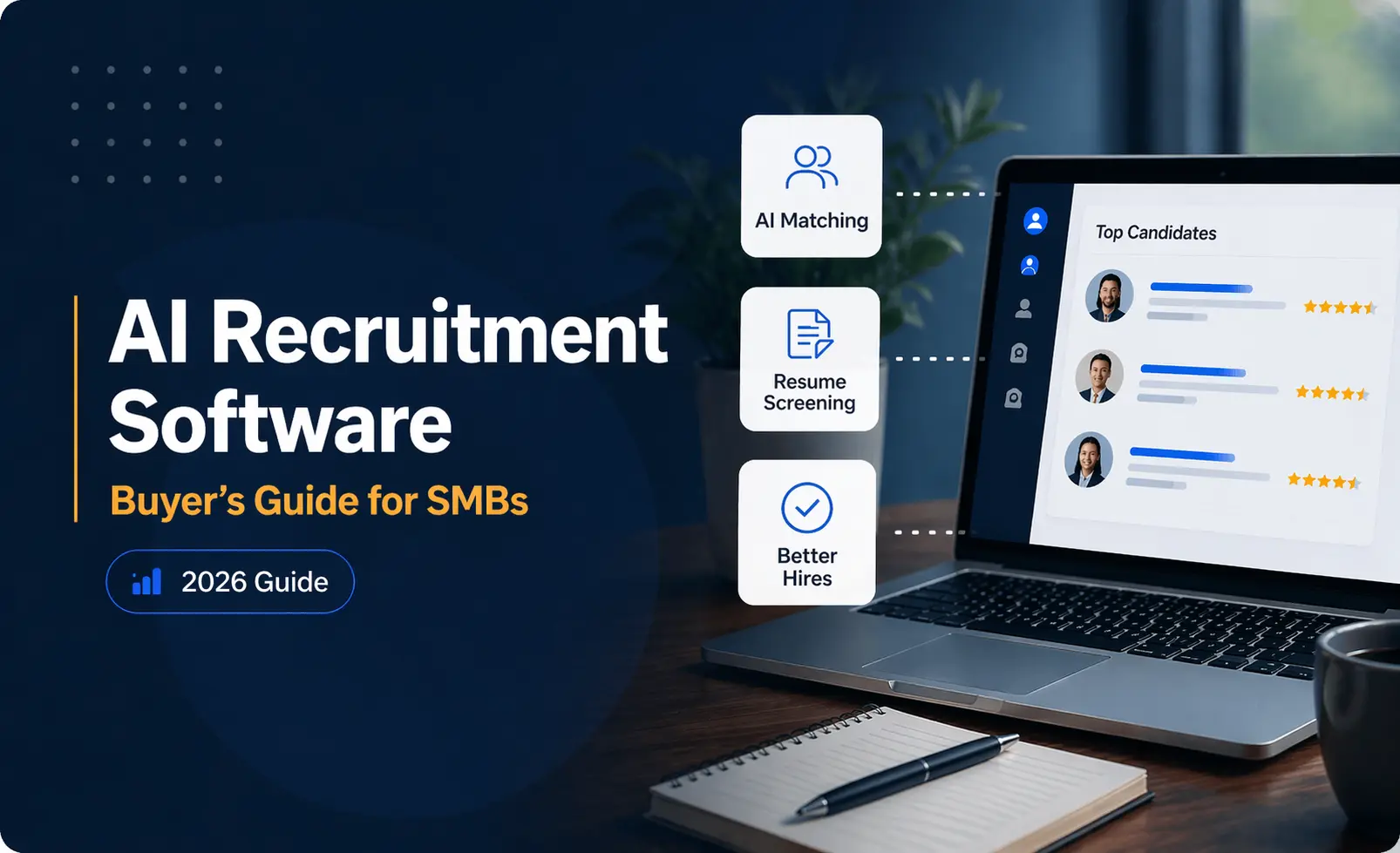
The average job posting draws 118 to 180 applications (HiringThing, 2025). At 75 seconds per resume, the real-world midpoint observed in recruiter studies, that's over three hours of screening before a single interview is scheduled. For a growing SMB where the HR lead also manages onboarding, payroll questions, and manager escalations, those three hours don't materialise from nowhere. They come at the cost of something else.
AI recruitment software exists to give that time back. But the market has expanded fast, pricing is opaque, and most comparison guides were written by people who didn't test the tools against a real hiring workflow. This guide is different. We assessed eight platforms on AI accuracy, true monthly cost, SMB fit, compliance features, and integration ease, and matched each to the hiring situations where it actually makes sense.
For a deeper look at the screening component specifically, see our complete guide to AI resume screening for SMBs.
43% of organisations now use AI in HR, up from 26% in 2024 (SHRM, 2025). This guide compares 8 tools by SMB fit, current published pricing, trade-offs, and persona-based recommendations.
What Does AI Recruitment Software Actually Do?
43% of organisations now use AI in at least one HR function, up from 26% just a year earlier (SHRM, 2025). Among those already using AI for hiring, 89% report measurable time savings and 36% report direct cost reductions. The tools producing those results fall into three broad categories.
Screening and ranking tools analyse CVs against job criteria and surface a shortlist for human review. Instead of reading applications linearly, a recruiter reviews the highest-ranked group and spot-checks the next tier. Accuracy depends on the document mix, role criteria, and benchmark method, so buyers should test vendors against the same labelled set of real applications.
ATS platforms with AI features handle the full hiring workflow, posting, application collection, candidate communication, interview scheduling, offer management, with AI layered in at the screening and sourcing stages. Most modern ATS platforms added AI features between 2023 and 2025. The question is whether those features genuinely improve screening quality or just add a score to the same keyword match.
Outbound sourcing tools search the open web and professional databases for passive candidates who match a role, then automate the initial outreach. These work best for specialised or senior roles where inbound applications are thin.
Most SMBs need a screening tool or a lightweight ATS with AI. The enterprise sourcing platforms in this guide are included for completeness, but the recommendation at SMB scale is clear: match the tool to your bottleneck, not to the most feature-rich option.
If you are still defining the use case, start with where AI fits in recruitment and where it does not, then map the repeatable step with our recruitment automation guide.

How We Evaluated These Tools
We scored each platform on five criteria weighted for SMB relevance:
- AI accuracy and methodology, Does the vendor disclose how their AI works? Are accuracy claims independently verified or just marketing statistics?
- True monthly cost, Starting price plus common add-ons for a 2-person HR team running 10–15 active roles.
- SMB fit, Does the onboarding experience suit a small HR team, or does it assume a dedicated IT and ops function?
- Compliance features, Does the platform address EEOC risk, audit logging, and data protection for UK/EU and US markets?
- Integration ease, Can it connect to tools SMBs actually use (Google Workspace, Slack, LinkedIn, Outlook) without custom development?
Our finding: Most AI recruitment platforms lead with time-to-hire statistics in their marketing. None of the eight tools we reviewed provide third-party verified accuracy benchmarks in their public documentation. Ask any vendor for accuracy data specific to your job categories before signing, not aggregated platform statistics.
The 8 Best AI Recruitment Software Tools for SMBs in 2026
1. Hire Forge AI, Best Dedicated AI Screener for SMBs
Hire Forge AI focuses on one problem: screening resumes faster and more accurately than a human can alone. Rather than trying to be a full ATS, it plugs into your existing workflow and returns a ranked shortlist. For SMBs that already have a basic ATS (or use a spreadsheet) and need better screening quality, it's the most focused option in this comparison.
The platform screens against job-specific criteria you define, flags skills gaps, and produces a ranked shortlist with scoring rationale. You see why each candidate ranked where they did, not just a number.
If you're deciding whether to add a dedicated screener or upgrade your ATS, see our ATS vs dedicated AI screener comparison for SMBs.
Best for: SMBs hiring 10–50 people per year who want better screening quality without replacing their existing workflow.
Pricing: For a detailed cost model, see resume screening ROI for teams under 200.
2. Manatal, Best Budget ATS with Built-In AI
At $15/user/month on the Professional plan (annual billing), Manatal is one of the most affordable full-featured ATS options with AI capabilities. The Professional plan supports 15 active jobs and 10,000 candidates, enough for many SMBs, and includes AI candidate scoring, LinkedIn profile enrichment, and a drag-and-drop Kanban pipeline.
Manatal's AI works by matching candidate profiles against job descriptions using a proprietary scoring algorithm. Scores appear as a percentage match with a category breakdown by skill area. Compare its output with other shortlisted tools using the same role and consented CV batch, then review each result against a reference shortlist, ranking quality, and false negatives.
The Enterprise plan ($35/user/month annual) removes job and candidate limits and adds workflow automation. Enterprise Plus ($55/user/month) adds API access, ChatGPT integration, and SSO.
The 14-day free trial doesn't require a credit card. That's enough time to run a real role through the system and evaluate accuracy with your own job description and applicant pool.
Best for: Budget-conscious SMBs who want an ATS and AI in one package for under $20/user.
Limitations: The 15-job cap on Professional limits teams hiring across multiple roles simultaneously. Screening quality should be tested against the same role, consented CV batch, reference shortlist, ranking-quality criteria, and false-negative review used for every shortlisted tool.
For a direct product comparison, see Hire Forge AI vs Manatal: which is better for small teams.
3. Zoho Recruit, Best for Teams Already in the Zoho Ecosystem
Zoho Recruit's Professional plan ($50/user/month annual) includes Zia AI for candidate matching, a Sourcing Bot that searches for passive candidates, and a Screening Bot that pre-qualifies applicants automatically. Eight additional agentic AI features landed in Q4 2025, making this the most aggressive AI push in Zoho Recruit's history.
For teams already using Zoho CRM, Zoho Books, or Zoho People, the native integration eliminates the connectivity problems that come with mixed-stack setups. Candidate history, communication logs, and offer data flow between modules without manual export and import.
The free plan (1 user, limited features) is genuinely useful for evaluating whether the platform suits your team before committing. You don't need to take a vendor demo to understand if the UI works for you.
Best for: SMBs already in the Zoho ecosystem who want AI features at mid-tier pricing without a second vendor relationship.
Limitations: AI features are Professional plan only. Teams outside the Zoho ecosystem lose the integration advantage that justifies the price premium over Manatal.
4. CVViZ, Best AI Screening Layer Without a Full ATS
CVViZ's model is different from every other tool here: it sells AI screening as a standalone service, not bundled into an ATS. The Starter plan ($99/month for 5 active jobs) is the lowest entry point for dedicated AI screening in this comparison.
The Resume Screening add-on ($25/job) deserves specific attention: it lets SMBs pay per-role rather than a flat monthly fee. Ten hires in January, none in February, you pay for January only. This suits teams with genuinely variable hiring volume better than any monthly subscription model.
CVViZ integrates with major ATS platforms via API or Zapier, so existing Workable or Greenhouse users can add AI screening accuracy without migrating to a new system.
Best for: SMBs with an existing ATS who want to improve screening quality without switching platforms.
Limitations: The per-job add-on model becomes expensive at volume above 20 active roles. The platform is less polished than Manatal or Workable on UX.
5. Breezy HR, Best for Visual Pipeline Management
Breezy HR's Startup plan ($157/month, unlimited users) hits an unusual price point: a flat monthly fee with no per-seat cost. For SMBs with multiple hiring managers who all need access, this model eliminates the per-user friction that makes tools like Manatal expensive at team scale.
The AI features, candidate evaluation summaries, resume auditing, automated job posting, are solid rather than exceptional. The standout is the visual pipeline interface: a Kanban-style board with candidate cards that non-technical HR users and line managers find genuinely easy to use without training.
The Growth plan ($273/month) adds interview self-scheduling, SMS communication, and video interviews without extra add-on fees, a meaningful simplification over Workable's add-on billing model.
Best for: SMBs with 5+ hiring managers who need a shared ATS at a predictable flat cost, and where ease of adoption matters as much as AI depth.
Limitations: The AI layer is less sophisticated than Manatal's scoring or dedicated screeners. Best for teams where collaboration and access simplicity are the primary constraints.
6. Workable, Best All-in-One for Growing SMBs
Workable's Standard plan ($299/month) is the most feature-complete entry point in this comparison. It includes an AI screening assistant, access to a 400M+ candidate database for outbound sourcing, one-click posting to 200+ job boards, and structured interview kits, all in one platform.
99% of hiring managers now report using AI in some part of the recruitment process (Insight Global, 2025). Workable is often the platform making that true at the SMB level.
The add-ons on Standard are where the cost diverges from expectations: video interviews cost $109/month extra, SMS texting is $89/month extra, and assessments are $59/month extra. Workable's Enterprise plan starts at $719/month and includes those three capabilities.
Workable's AI sourcing feature actively surfaces candidates from its database who match your open roles. For hard-to-fill specialist positions where inbound applications are consistently thin, this is a genuine advantage over tools that only screen inbound applicants.
Best for: Growing SMBs with 50–200 employees ready to consolidate on one platform and with budget to support it.
Limitations: The Standard plan's add-on billing makes true cost opaque. Build a full-cost scenario before comparing to competitors. The $299/month entry is difficult to justify for teams under 50 employees with fewer than 15 hires per year.
For a focused comparison on screening-specific features, see Hire Forge AI vs Workable: when you need a screener, not a full ATS.

7. hireEZ, Best for Outbound Candidate Sourcing
hireEZ combines outbound sourcing, candidate relationship management, analytics, automation, and ATS-connected workflows. It can sit over an existing ATS rather than requiring a full migration.
The published Solo plan starts at $494/month and includes a 7-day trial. Enterprise pricing is custom and hireEZ recommends a four-week verification process before purchase (hireEZ pricing, checked July 2026).
The AI features go beyond matching: hireEZ surfaces candidates hidden in your existing ATS database who were rejected or passed over for earlier roles, matching them against new openings. For agencies or SMBs with large historical candidate databases, this "talent rediscovery" feature can fill roles without sourcing credits.
Best for: SMBs where inbound applications are consistently too thin for specialist or senior roles, and where sourcing is the primary constraint.
Limitations: At $494+/month for Solo, hireEZ is expensive for general SMB use. Teams should verify that sourcing and workflow gains justify adding another layer to their existing ATS.
8. Greenhouse, When You've Outgrown SMB Tools
Greenhouse is the most structured, compliance-focused ATS in this comparison. Interview scorecards, DE&I reporting, granular permission controls, and 400+ integrations make it the natural choice for companies with formal, multi-stakeholder hiring processes.
It's also the most expensive. Estimated pricing for a small team starts around $5,100–$6,500/year on the Essential plan. SpendHound benchmark data shows SMB pricing increased 53% year-over-year. Implementation adds $1,000–$5,000 for basic setup.
Best for: SMBs that have grown past 200 employees and need enterprise-grade process structure, or companies in regulated industries where audit trails are a legal requirement.
Limitations: Cost-prohibitive for most SMBs. AI features are less central than workflow structure and compliance tooling.
AI Recruitment Software Pricing Comparison
The published pricing landscape spans from $15/user/month (Manatal Professional, annual) to hundreds of dollars per month for broader sourcing and ATS suites. That range reflects the fact that these tools don't solve the same problem: a dedicated AI screener and an enterprise hiring platform are different products.
Important: The listed price is rarely the total cost. Workable's Standard plan is $299/month until you add video interviews ($109/mo), SMS texting ($89/mo), and assessments ($59/mo), bringing the realistic monthly total to $556 before any per-seat scaling. Always model the full-cost scenario for your actual team before comparing plans.
For a complete cost breakdown with true per-hire numbers, see our AI recruitment software pricing guide for 2026.
Which AI Recruitment Tool Is Right for Your SMB?
The right tool depends on your team size, hiring volume, and where your biggest constraint sits. These four scenarios cover the most common SMB situations.
Startup, 10–30 employees, fewer than 10 hires per year. You don't need a full ATS. Applicant volume is manageable with a basic spreadsheet or a free-tier tool. The real constraint is screening quality, you're not getting 150 applications, but you are wasting two hours per role sorting through unqualified CVs. A dedicated AI screener gives you accuracy without ATS overhead. Start with a trial before paying for a subscription.
Growing SMB, 30–100 employees, 10–25 hires per year. This is where an ATS-plus-AI combination starts to justify its cost clearly. Manatal's Professional plan at $15/user/month handles workflow and AI screening for $30/month for a 2-person HR team on annual billing. Zoho Recruit Professional ($50/user/month) is worth considering if you're already in the Zoho ecosystem. CVViZ ($99/month) works if you have an existing ATS and just want to improve the screening layer.
Scaling SMB, 100–200 employees, 25–50 hires per year. Workflow automation becomes as important as screening accuracy at this volume. Workable's Standard plan starts at $299/month for companies with 1–20 employees; model the $109 video, $89 texting, and $59 assessment add-ons or compare the $719 Enterprise tier before choosing.
Staffing agency, 1–10 recruiters, multiple client roles. Agencies need multi-client candidate separation, variable-volume pricing, and branded career pages. CVViZ's per-job model suits agencies with inconsistent hiring flow. Manatal's Enterprise plan includes agency-specific features.
For agency-specific guidance, see our complete guide to AI tools for staffing agencies.
What to Look for When Buying AI Recruitment Software
Accuracy Claims Aren't Standardised
LinkedIn reports that talent-acquisition professionals experimenting with or integrating generative AI save about 20% of their work week (LinkedIn Future of Recruiting, 2025). That is a time-saved benchmark, not proof that a particular screener improves hiring quality. Ask vendors for accuracy data specific to your role types and validate their ranking against a labelled sample.
True Cost Includes Add-Ons and Setup Time
The monthly price on a pricing page is rarely the total cost. Common add-ons that inflate real cost include video interview functionality, SMS candidate communication, additional sourcing credits, API access (often Enterprise-tier only), and SSO and security features. Implementation also isn't free: even platforms with "instant setup" require configuring job templates, scoring criteria, and integrations. Budget 2–5 hours of setup time per role type in the first month.
Integration with Your Existing Stack
Most SMBs run Google Workspace or Microsoft 365. An ATS that can't push interview invites to Google Calendar or Outlook creates a manual handoff that undermines the time-saving argument entirely. Check native integrations specifically, not the "1,000+ integrations via Zapier" claim, which is not the same as a maintained native connector.
Trial Quality Over Sales Demos
A 14-day free trial run against a real open role is worth more than three vendor demos. The difference between a tool that works in a polished walkthrough and one that works in your actual workflow only appears when you test it with your own job descriptions, your own applicant volume, and your own team's processes.

AI Hiring Compliance: What Every SMB Must Know Before Buying
The legal environment around AI hiring tools shifted significantly in 2023–2025. SMBs can't treat compliance as a vendor concern, it's an employer obligation.
UK and EU buyers should use the operational checklist in our GDPR-compliant AI recruitment guide before uploading live candidate data.
The EEOC Precedent That Changed the Conversation
The EEOC's first AI hiring discrimination settlement (EEOC v. iTutorGroup, August 2023) resulted in a $365,000 payout after an AI system automatically rejected over 200 applicants based on age and gender. The case established a critical principle: employers, not vendors, bear liability for discriminatory outcomes produced by AI tools they chose to deploy.
That liability structure means "the vendor's AI made the decision" is not a defence.
California's ADS Regulations (Effective October 2025)
California's Civil Rights Council Automated Decision System regulations, effective October 1, 2025, prohibit use of any automated decision system that produces discriminatory outcomes based on protected characteristics in hiring. For any SMB hiring California residents or operating in California, this creates a compliance obligation beyond federal EEOC requirements.
Practically, this means documentation of how the AI system makes decisions, evidence of disparate impact testing, and a process for human review of AI-flagged rejections.

Five Questions to Ask Any AI Recruitment Vendor
Before signing, ask each vendor these specific questions:
- How does your AI make screening decisions? Is the scoring logic explainable to candidates?
- Have you conducted disparate impact testing on your screening model? When was it last updated?
- Who bears liability if the system produces discriminatory outcomes in hiring?
- Do you provide audit logs sufficient for EEOC or state agency documentation requests?
- Are you compliant with California ADS regulations effective October 2025?
Our finding: During research for this guide, we posed these compliance questions to five AI recruitment vendors. Only two provided direct answers. The other three redirected to generic privacy policy pages. Any vendor unable to answer question 3 directly should be treated as a compliance risk.
Only 26% of job applicants in a Gartner survey of 2,918 candidates trusted AI to evaluate them fairly (Gartner, 2025). Candidate trust isn't just an ethics issue; it can affect the candidate experience and employer brand.
For a full compliance checklist for SMBs, see our AI resume screening bias risk and compliance guide.
How AI Recruitment Metrics Compare: A Before/After View
The most defensible cross-industry evidence is about efficiency rather than a guaranteed hiring outcome. SHRM reports that 89% of organisations using AI in recruiting save time or increase efficiency, while LinkedIn reports that GenAI adopters save about 20% of their work week. Treat those as evaluation benchmarks, not promised results for an individual deployment.
Talent-acquisition professionals experimenting with or integrating generative AI report saving about 20% of their work week (LinkedIn Future of Recruiting, 2025). Convert that percentage using your own loaded hourly cost before putting a savings figure into a business case.
For a detailed break-even calculation with your team's actual numbers, see resume screening ROI: is AI worth it for teams under 200?.
The AI Recruitment Market in 2026: What It Means for Buyers
The global AI recruitment software market was valued at $704.54 million in 2025 and is projected to reach $1,119.79 million by 2032 at a 6.8% annual growth rate (Maximize Market Research, 2025). North America holds a 38.6% market share.
What that trajectory means for SMB buyers: the tool you choose today will look meaningfully different in 18 months. Vendors are shipping AI features at a pace that makes year-old reviews unreliable. The acquisitions happening at the enterprise tier (Paradox was acquired by Workday for $1 billion in October 2025) suggest consolidation is coming. Smaller SMB-focused vendors are being bought or shut down.
Practically: choose a platform with a clear, actively-communicated product roadmap. Favour vendors who ship frequently over vendors who announce big feature releases on annual cycles. Check the changelog before the pricing page.
35.5% of SMBs already allocate part of their recruitment budget to AI tools (DemandSage, 2026). The gap between SMBs using AI hiring tools and those that aren't is widening, not in terms of technology, but in hiring speed and quality of candidate pools.
Most free AI recruitment tiers strip out the AI features entirely. Zoho Recruit and Breezy HR offer free plans, but AI screening requires paid tiers ($50/user/month and $157/month respectively). For genuine AI screening at no initial cost, prioritise platforms with a 14-day credit-card-free trial (Manatal, CVViZ) over free tiers that limit you to basic ATS functionality without the screening quality improvements.
For a 20-person SMB with a 2-person HR team, published monthly costs range from $30/month (Manatal Professional for 2 users on annual billing) to $299/month (Workable Standard before add-ons). CVViZ at $99/month works for teams with 5 or fewer active roles. Always build a full-cost scenario before comparing plans.
AI resume screening is legal but regulated. The EEOC holds employers (not vendors) liable for discriminatory AI outcomes, established in the 2023 iTutorGroup settlement ($365,000). California's ADS regulations (effective October 2025) add state-level requirements. In the UK, ICO guidance on AI in hiring requires transparency and bias monitoring. Ask any vendor for their disparate impact testing documentation before deployment.
There is no single credible accuracy percentage for AI resume screening. Results vary with document quality, role criteria, ground-truth labels, and the metric a vendor reports. Test every shortlisted product against the same labelled application set and review false negatives, not just its headline accuracy.
Staffing agencies need multi-client candidate separation, variable-volume pricing, and branded career pages. CVViZ's per-job pricing model suits agencies with inconsistent hiring volume. Manatal's Enterprise plan includes agency-specific workflow features. Zoho Recruit Professional works for agencies already in the Zoho ecosystem. For a complete agency-specific comparison, see our guide to AI tools for staffing agencies.
The Bottom Line: Match the Tool to Your Bottleneck
The best AI recruitment software for your SMB is the one that solves your specific constraint without adding overhead you don't need. A platform with 200 features isn't better than one with 20 if those 20 are the ones that matter.
If screening volume and quality are the problem, a dedicated AI screener delivers the fastest return. If you need a full hiring workflow plus AI in one place, Manatal's pricing is the hardest to argue with at the SMB tier. If your team is already deep in Zoho, Zoho Recruit Professional gives you AI features without a second vendor relationship. If you're ready to invest in a consolidated platform and can absorb the cost, Workable handles the most of the workflow.
The 35.5% of SMBs already allocating budget to AI recruitment tools (DemandSage, 2026) aren't doing it because it's a trend. They're doing it because the maths on recruiter time, time-to-hire, and candidate quality eventually becomes impossible to ignore.
If CV extraction quality is the bottleneck behind those results, compare the same tools against the 300-CV resume-parser benchmark before buying a broader platform.
See the full pricing breakdown across every tool in our AI recruitment software pricing comparison for 2026.
Ready to try Hire Forge AI?
Upload your job description and CVs to see a ranked shortlist built around the evidence that matters.
5 CVs before signup. 100 more free. No card.
Keep exploring
Related guides
AI Recruitment Software Pricing 2026: What SMBs Actually Pay
AI recruitment tools start at $15/user/month and scale to enterprise contracts. Compare verified 2026 pricing, add-ons, and SMB fit.
AI Tools for Staffing Agencies: The 2026 Complete Guide
Compare AI tools for staffing agencies with 2–20 recruiters across sourcing, screening, ATS/CRM, parser APIs, pricing and cost per placement.
Best ATS for Small Staffing Agencies: 8 Compared (2026)
Compare eight ATS platforms for small staffing agencies by pricing, agency workflows, CRM depth, sourcing, automation and specialist screening fit.
About the author
Ben Lovis·Founder, Hire Forge AIA professional recruiter who built and deployed AI-powered screening systems internally before founding Hire Forge AI. He now designs AI recruitment systems for hiring teams worldwide.
Compare Hire Forge using your own CVs
Run a real role through Hire Forge and review the ranked shortlist, supporting evidence and gaps before deciding whether it fits your process.
Start free5 CVs before signup. 100 more free. No card.