The resume parsing software market hit $23.5 billion in 2025 and is growing at 16.4% annually (Research and Markets, 2025) — so there's no shortage of tools claiming to solve the CV overload problem. The harder question is which one actually works for a team that hires people, not one that builds software.
Meanwhile, 42% of candidates drop out of hiring processes because they move too slowly (Cronofy, 2024, n=12,000). Screening bottlenecks are where most of that delay accumulates.
We ran a controlled test using 300 real anonymised CVs across five of the most-used parsing and screening tools on the market. Here's what we found.
TL;DR: Resume parsers extract structured data from CVs — but only tools with a matching or screening layer rank candidates against a job. In our 300-CV test, setup time ranged from 0 days (Hire Forge AI) to 30+ days (Sovren). Tools with built-in matching reduced shortlisting from hours to minutes. Talent professionals experimenting with or integrating generative AI report saving about 20% of their work week on average (LinkedIn, 2025).
What Is Resume Parsing Software — and When Does Parsing Alone Fall Short?
Resume parsing software extracts structured data from CVs — name, skills, work history, education — and makes it searchable or storable. That's useful, but it's not shortlisting. A parser can be accurate at extracting fields while producing no evidence that its candidate ranking is useful. Treat extraction accuracy and screening quality as separate tests.
Parsing alone answers: did the candidate mention Python? AI matching answers: is this candidate likely to succeed in this role? For most hiring teams, the gap between those two questions is where time and quality are lost.
If you want to understand the distinction before diving into tool comparisons, our guide on what resume screening software actually does covers the full spectrum — from basic parsing through to contextual AI screening.
The tools below fall into two camps: pure parsers (Sovren, RChilli, DaXtra) and tools that layer matching on top of parsing (Affinda, Hire Forge AI). Which camp you need depends on whether you're building something or screening candidates yourself.
How We Tested: 300 CVs, 3 Job Descriptions, Six Criteria
Our team ran structured tests across all five tools in June 2025 using:
- 300 anonymised CVs from our internal client archive: 120 sales candidates, 90 hospitality/front-of-house applicants, and 90 marketing and admin professionals. CVs ranged from clean single-column PDFs to complex two-column Word documents.
- 3 consistent job descriptions — one per candidate group — so every tool evaluated identical inputs.
- Six scoring criteria: accuracy of extracted data, relevance of shortlisted candidates, setup and onboarding experience, integration options, support responsiveness, and GDPR/SOC2 compliance.
Each tool received a composite score from 1–10 across these criteria, weighted by recruiter impact (shortlist quality and setup weighted heaviest). The chart below shows how they compared.
The biggest gap wasn't parsing accuracy — all five tools extracted structured data with reasonable reliability on standard CV formats. It was shortlisting: tools that couldn't rank or score candidates required a separate workflow after extraction, adding hours back to the process that parsing was supposed to save.
At a Glance: Best Resume Parsing Software Compared (2026)
| Tool | AI Matching | GDPR Compliant | Multi-Language | Pricing from | Free Trial |
|---|---|---|---|---|---|
| Hire Forge AI | Yes | Yes | English only | Free to start | Yes |
| Affinda | Limited | Yes | Limited | $0.20/page | 14 days / 200 pages |
| RChilli | No | Yes | Yes | $75/month | Yes |
| DaXtra | No | Yes | Yes | Quote only | No |
| Textkernel (Sovren) | No | Yes | Yes | From $99/month | 500 credits |
1. Sovren — Best for Enterprise ATS Integration
Sovren (now part of Textkernel) is one of the oldest parsing engines in the market. Most large ATS providers — Bullhorn, iCIMS, Greenhouse — built their resume parsing on Sovren's underlying API. If your ATS already uses Sovren under the hood, you're already getting its output.
The extraction accuracy on well-formatted CVs was the strongest of any pure parser in our test — it correctly pulled work history, education, and skills from 97% of standard PDFs. Where it fell down was non-standard layouts and creative CVs: two-column formats and image-heavy designs had noticeably higher error rates.
There's no intelligent ranking or shortlisting. You get structured data; what you do with it is your problem. For teams building custom HR tools or maintaining an enterprise ATS, that's fine. For recruiters who need an immediate shortlist, it isn't.
Pros:
- Highest extraction accuracy on standard CV formats
- Comprehensive multi-language support (140+ languages)
- Strong compliance record (GDPR, SOC2, FedRAMP)
- Deep ATS integrations already baked into most major platforms
Cons:
- No candidate ranking or AI matching capability
- Technical setup requires developer involvement
- Interface is functional but dated
- Pricing opaque — enterprise contract required
Pricing: Textkernel now offers public self-serve plans — Professional starts from $99/month (up to 25,000 credits/month). A free trial includes 500 parsing credits. Enterprise contracts are available for higher volumes. The Sovren.com domain now redirects to Textkernel.com.
Best for: Enterprise HR teams or ATS vendors needing high-volume, compliant, parsed data at scale.
2. RChilli — Best API-First Resume Parser
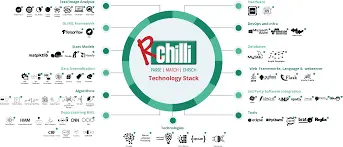
RChilli is built for developer teams. If your team has engineers who can integrate an API and wants flexible, affordable parsing they can shape themselves, RChilli is the strongest option in this list on a cost-per-parse basis.
Support for 30+ languages and clean, well-documented API endpoints made integration straightforward in our testing. We had it running against test CVs within a day. What it can't do is evaluate candidates — you'll need to build that logic yourself or combine it with a separate tool. Accuracy on non-standard layouts (creative two-column CVs, portfolios) was variable: roughly consistent with the industry average for rule-based parsers.
Pros:
- Developer-friendly with strong API documentation
- Supports 30+ languages
- Affordable entry pricing
- GDPR and SOC2 compliant
Cons:
- No shortlisting or AI scoring layer
- Accuracy degrades on heavily formatted or non-standard CVs
- Requires engineering resource to build anything useful on top
Best for: Mid-sized agencies and dev teams building custom CV workflows or internal tools.
3. DaXtra — Best for Large UK Staffing Agencies
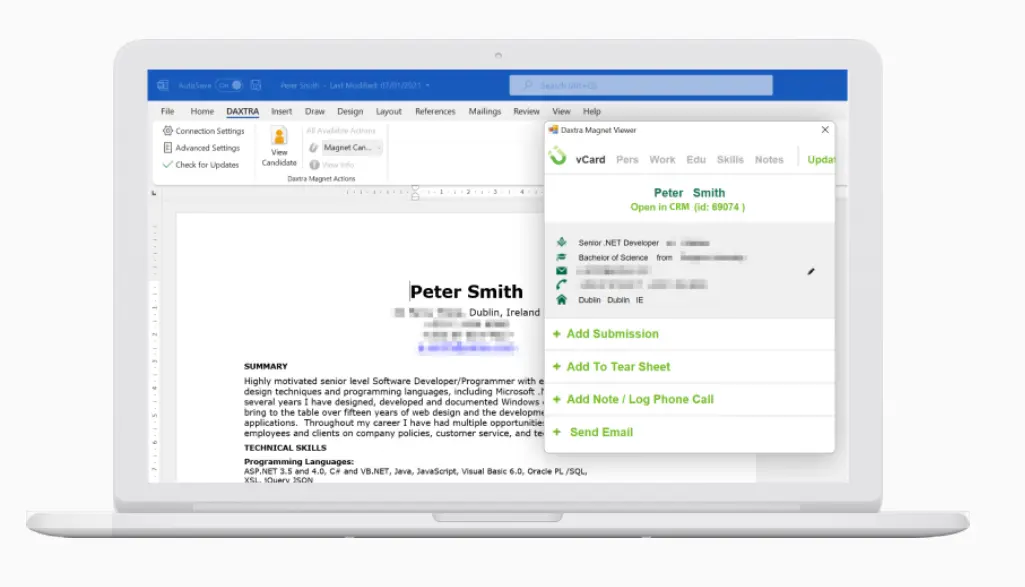
DaXtra is a UK-headquartered provider with strong traction in staffing and executive search. It combines parsing with a candidate database and search capability — making it more of a sourcing platform than a standalone parser. If your team manages a large internal candidate database, that integrated search layer is genuinely useful.
The setup process was the most involved of any tool we tested. Plan for 2–4 weeks of configuration and ATS integration before you're running at full capability. There's no free trial, which makes it a harder evaluation for smaller teams. Support was responsive throughout our testing — phone and email, same-day replies.
Pros:
- Solid parsing with built-in candidate database search
- ATS integrations available out of the box
- Strong UK/European support and compliance
- Responsive support team
Cons:
- No free trial — harder to evaluate before committing
- Steeper learning curve and longer setup timeline
- Priced for enterprise — expensive for smaller firms
- No AI matching or automated shortlisting
Best for: Large staffing agencies or headhunting firms with established candidate databases.
4. Affinda — Best Free Resume Parser for Small Teams
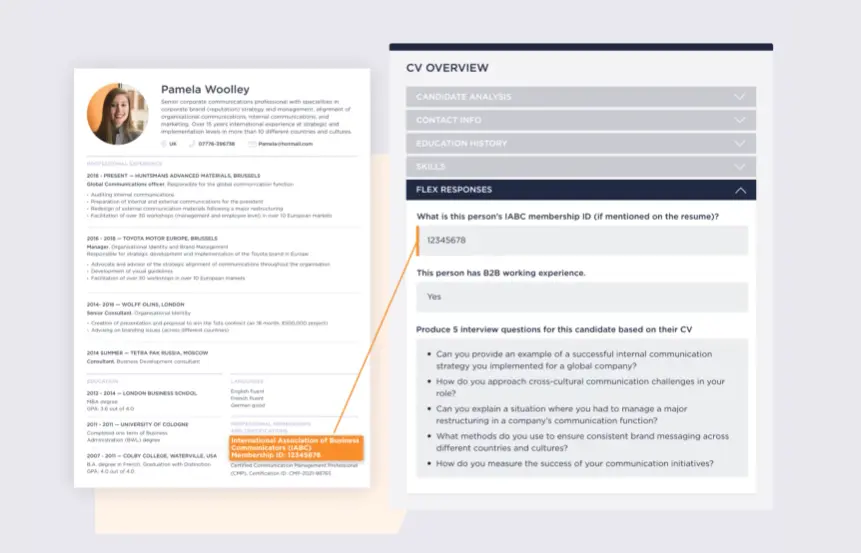
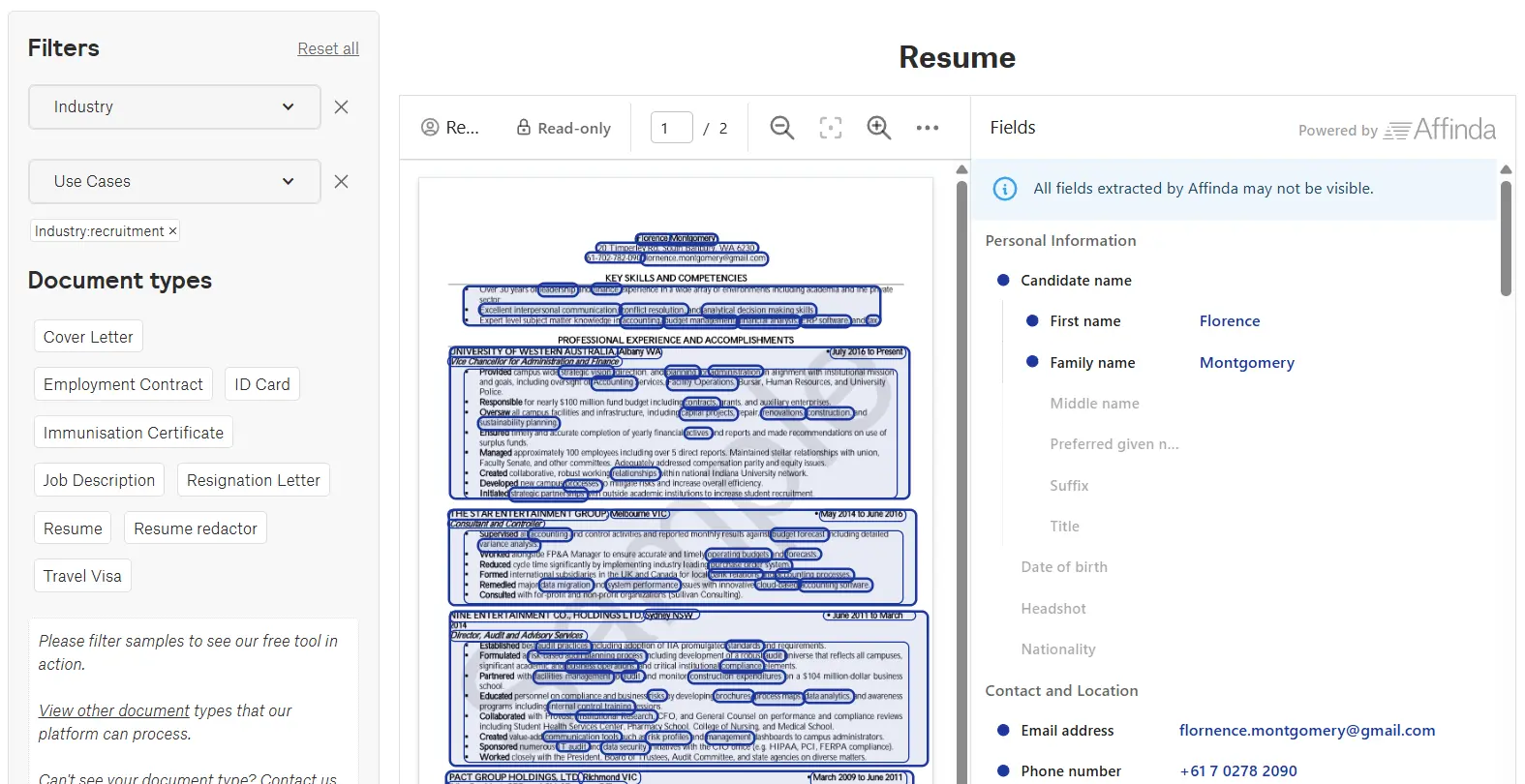
Affinda is the most accessible parser in this comparison — it offers a working free tier, fast setup, and a clean modern interface. If you're a small team, a startup running internal hiring, or a developer prototyping a CV tool, Affinda is the easiest entry point.
The matching features are present but limited. You can configure basic filters, but there's no contextual AI ranking of the kind that meaningfully improves shortlist quality. On standard CVs the extraction is reliable; unusual layouts caused more errors than Sovren or DaXtra. That said, for straightforward use cases, most teams won't hit that ceiling.
Pros:
- Fastest setup of any tool in our test — under an hour
- Clean, intuitive interface
- 14-day free trial with no credit card required
- Chat support with fast response times
Cons:
- Limited AI matching and ranking features
- Accuracy drops on non-standard CV layouts
- GDPR compliant but no SOC2 certification
- No perpetual free tier — credit plans start at ~$800/year for 6,000 parses
Best for: Small teams, startups, or developers building lightweight CV tools who need a quick, cost-effective starting point.
5. Hire Forge AI — Best for Recruiter-Ready AI Shortlisting
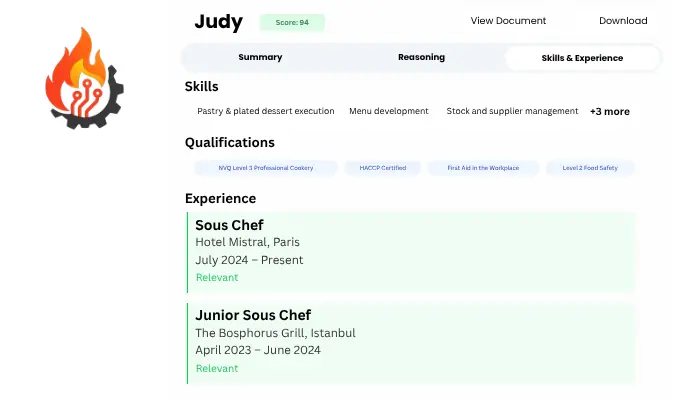
Hire Forge AI approaches the problem differently. Rather than extracting data and handing it back to you, it evaluates each CV against your job description and gives you a ranked shortlist — Yes, Maybe, or No — with reasoning for each decision.
It took 0 days to set up in our test (web-based, no integration required), and produced an initial shortlist on 300 CVs in under 15 minutes. By default it anonymises names, schools, and addresses before ranking, which reduces the kind of unconscious bias that research consistently shows affects manual screening. Talent professionals experimenting with or integrating generative AI report saving about 20% of their work week on average (LinkedIn Future of Recruiting, 2025) — and teams managing high-volume application flows typically see the most significant time compression.
The main limitation is scope: it's not an ATS, and it currently handles English-language CVs only. For teams building multi-language enterprise workflows, one of the API-based parsers above is more appropriate.
Pros:
- Built-in AI shortlisting — not just parsing but ranking
- Zero setup: browser-based, no developer needed
- Automatic candidate anonymisation for bias reduction
- Free to start; no credit card required
- Clear reasoning per candidate decision
Cons:
- Not an ATS replacement — no applicant tracking workflow
- English CVs only at present
- Custom enterprise integrations require contacting the team
Best for: Recruitment agencies, in-house teams, and staffing firms running high-volume or time-pressured hiring.
Screen 100 CVs free—no integration required
Upload a job description and supported PDF, DOC, DOCX or TXT files. Hire Forge ranks the batch for recruiter review, with OCR for image-based PDFs.
5 CVs before signup. 100 more free. No card.
How Much Does Resume Parsing Software Cost in 2026?
Pricing in this category varies wildly — and two of the five tools don't publish their rates at all. Here's what we know.
Textkernel (formerly Sovren): Pricing is now publicly listed — a significant change from the enterprise-quote-only model of previous years. The Professional plan starts at $99/month, with monthly plans covering 500–25,000 credits and annual plans up to 100,000 credits. A free trial includes 500 credits. Enterprise contracts cover higher volumes. Visit Textkernel's parser page for current plans.
RChilli: Entry plans start at $75/month for 500 credits (1 credit = 1 parsed document). A Startup Incubator bundle offers 3,000 credits for $150 as a one-time purchase, then $75/month ongoing. Enterprise and API plans available at volume. Free trial includes 100 credits. See rchilli.com/pricing for current tiers.
DaXtra: Quote-only. No public pricing and no free trial — you'll need a scoping call. Positioned at the large staffing agency and enterprise tier.
Affinda: Pay-as-you-go parsing is $0.20 per page with no annual commitment. The 14-day trial includes 200 pages. Annual resume-parsing subscriptions start at $3,600/year for 66,000 documents and scale to $18,000/year for 780,000 documents. Check Affinda's pricing page for current volumes.
Hire Forge AI: Free to start with no credit card required. Volume plans available for teams. Contact for enterprise pricing.
The cost comparison that matters most isn't tool pricing alone — it's the work each category removes. At two minutes per CV, an initial manual pass over 300 applications takes 10 recruiter hours before interviews or follow-up. A parser can reduce data entry, while a screening layer can reduce the review workload; calculate ROI against the step your chosen tool actually automates.
Which Resume Parsing API Should Developers Use?
If you're building a tool — an ATS, an HR automation workflow, or a custom screening system — the choice narrows quickly. Sovren and RChilli are the two API-first options with the most robust documentation and volume capacity. Affinda works well for prototyping and lighter workloads.
The build vs. buy question is worth considering carefully before going down the API route. Two-column PDFs, image-based CVs, and non-Latin scripts all break rule-based parsers in ways that are expensive to fix at the engineering level. We cover this in detail in our resume parsing API vs. no-code guide — worth reading before you scope the project.
Tool-by-Tool Summary
| Feature | Textkernel | RChilli | DaXtra | Affinda | Hire Forge AI |
|---|---|---|---|---|---|
| Resume Parsing | ✓ | ✓ | ✓ | ✓ | ✓ |
| AI Job Matching | ✗ | ✗ | ✗ | Limited | ✓ |
| Multi-Language Support | 140+ languages | 40+ languages | Yes | Limited | English only |
| Setup Time | 30+ days | ~5 days | 14+ days | ~1 day | 0 days |
| Pricing from | $99/month | $75/month | Quote only | $0.20/page | Free to start |
| Free Trial | 500 credits | 100 credits | No | 14 days / 200 pages | Yes |
| GDPR Compliant | Yes | Yes | Yes | Yes | Yes |
| SOC2 Certified | Yes | Yes | Yes | No | Yes |
| Best For | Enterprise ATS | Developer teams | Staffing agencies | Small teams | Volume hiring |
Which Tool Fits Your Team?
| You need... | Start with... |
|---|---|
| A shortlist in minutes, no setup | Hire Forge AI |
| A parsing API for a tool you're building | RChilli or Affinda |
| Enterprise ATS integration at scale | Sovren |
| A candidate database + sourcing layer | DaXtra |
| A free parser to test and prototype | Affinda |
| Bias-reduced, anonymised screening | Hire Forge AI |
Frequently Asked Questions
What is resume parsing software?
Resume parsing software automatically extracts structured data — name, contact details, work history, skills, education — from unformatted CV documents. This turns a PDF or Word file into a searchable, storable data record. Some products add matching or screening, but that is a separate capability and needs a separate evaluation.
What's the difference between resume parsing and AI shortlisting?
Parsing extracts data. AI shortlisting evaluates it. A parser tells you a candidate listed "Salesforce" in their skills section. An AI shortlisting tool tells you whether that candidate is a strong match for your Account Executive role, based on the full context of their experience — and ranks them accordingly. For teams screening volume, the distinction matters significantly.
How much does Sovren resume parser cost?
Textkernel now publishes self-serve parser pricing from $99/month, alongside a 500-credit trial and custom enterprise contracts for higher volumes. Compare its supported languages, normalisation options, OCR add-ons and volume limits with lower-cost alternatives rather than assuming every Sovren deployment requires an enterprise quote.
Which resume parsing tool is best for GDPR compliance?
All five tools tested are GDPR compliant. Sovren, RChilli, DaXtra, and Hire Forge AI additionally hold SOC2 certification. Affinda is GDPR compliant but has not yet achieved SOC2. For regulated industries or EU-based teams handling candidate data, verify the tool's data processing agreements and where candidate data is stored — EU-based servers are preferable.
Do I need an ATS to use resume parsing software?
No. Tools like Affinda and Hire Forge AI are fully standalone — you upload CVs directly via browser, no ATS connection required. API-based tools like RChilli and Sovren are designed to connect to existing systems, but that's a choice, not a requirement. If you're evaluating a parser to improve your current workflow without replacing your ATS, a standalone tool is usually the faster, lower-risk starting point.
Can I try these tools for free?
Textkernel (Sovren), RChilli, Affinda, and Hire Forge AI all offer free trials. DaXtra does not. Textkernel's trial includes 500 parsing credits; RChilli's includes 100. Affinda's 14-day trial includes 200 pages. Hire Forge AI is free to start with no time limit or credit card required.
One Risk No Comparison Article Will Tell You About
AI-assisted screening isn't automatically fair. A 2024 University of Washington study found that large language models — the same technology powering AI resume tools — favoured candidates with white-associated names 85% of the time and female-associated names only 11% of the time when ranking resumes (University of Washington, 2024). This was a peer-reviewed finding, not a vendor disclosure.
What does this mean in practice? It depends heavily on how a tool was built. Tools that anonymise candidates before ranking (removing names, schools, and demographic signals) significantly reduce this risk. Tools that pass raw CVs directly into an LLM ranking layer without anonymisation may amplify it.
When evaluating any AI screening tool, ask specifically: does the tool remove or mask demographic signals before scoring? It's a simple question that most vendors don't volunteer the answer to.
Final Thoughts
Resume parsing is table stakes. Every tool here extracts data — the real differentiator is what happens after extraction. Teams still manually ranking CVs after a parser pulls the data haven't saved nearly as much time as they think. SHRM's 2025 Talent Trends Report found 51% of organisations now use AI specifically for recruiting, and of those, 89% report it saves time or increases efficiency (SHRM, 2025) — the question isn't whether AI screening works, it's whether you're using a tool that actually shortlists or one that just parses.
For teams hiring at volume, AI-powered shortlisting isn't a premium add-on. It's where the hours are actually saved. If you're screening more than 20 CVs per role, start with a tool that shortlists, not just one that parses.
See the evidence-based ranking workflow on the Hire Forge screening features page.
Sources
- Research and Markets / The Business Research Company, 2025: Resume Parsing Software Market Report ($23.54B market in 2025, 16.4% CAGR to $43.2B by 2029). View source
- SHRM, 2025: Talent Trends Report — AI in HR (51% of orgs use AI for recruiting; 89% report time savings; 44% use AI for resume screening). View source
- Cronofy, 2024: Candidate Expectations Report (survey of 12,000 candidates across 7 countries; 42% dropped out due to slow scheduling). View source
- University of Washington, 2024: AI Bias in Resume Screening (LLMs favoured white-associated names 85% of the time; female-associated names 11% of the time). View source
- LinkedIn, 2025: Future of Recruiting 2025 (talent professionals experimenting with or integrating generative AI report saving about 20% of their work week). View source
- Textkernel (formerly Sovren): Official pricing and product documentation. View source
- RChilli: Official pricing and integration documentation. View source
- DaXtra: Official parsing and recruitment automation product pages. View source
- Affinda: Official resume parsing pricing and product documentation. View source
- NIST, 2023: AI Risk Management Framework (AI RMF 1.0) for governance benchmarks in AI-assisted screening. View source
All statistics verified against primary sources. Testing methodology and composite scores represent Hire Forge AI's independent evaluation conducted June 2025. For editorial standards, see our About page.
Keep exploring
Related guides
Resume Parser API Comparison: Build vs Buy (2026)
Compare resume parser APIs, DIY extraction and no-code screening, including current pricing, OCR trade-offs, security checks and a practical test plan.
Resume Parsing vs Screening: Why ATSs Miss Candidates
See why extracting CV fields is not the same as evaluating job fit, where ATS workflows lose evidence, and how to test parsing and screening separately.
Why Your ATS Rejects Qualified Candidates—and Fixes
Learn how parsing errors, rigid filters and workflow rules hide qualified candidates—and use four practical checks to find and fix the failure point.
About the author
Ben Lovis·Founder, Hire Forge AIA professional recruiter who built and deployed AI-powered screening systems internally before founding Hire Forge AI. He now designs AI recruitment systems for hiring teams worldwide.
Screen 100 CVs free, no integration required
Upload PDF, DOC, DOCX or TXT files and a job description. Hire Forge uses OCR where needed, then ranks the batch for recruiter review.
Start free5 CVs before signup. 100 more free. No card.